By David Lapham · Published
At a glance
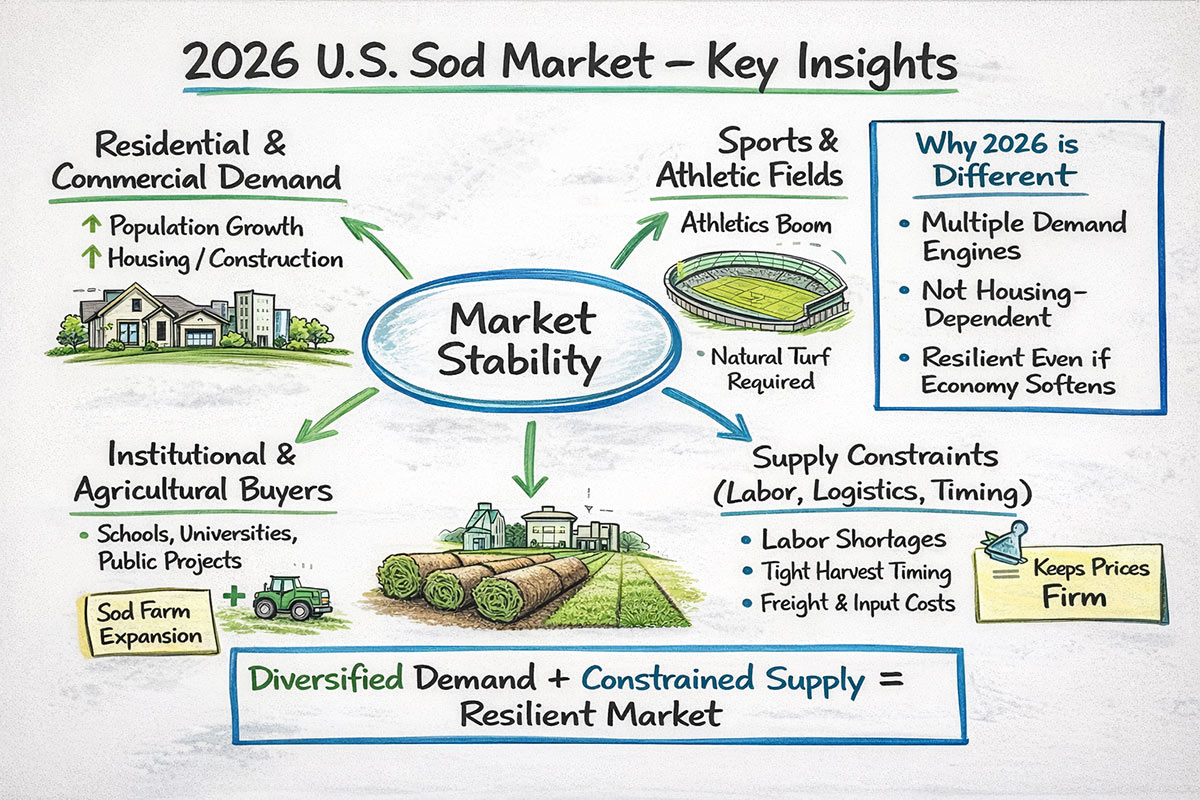
- 2026 sod demand is driven by four independent sectors: residential, commercial, sports turf, and institutional buyers.
- The market is more resilient than past cycles because demand is no longer housing-dependent.
- Supply constraints are operational (labor, logistics, harvest timing), not land-based.
- Prices are expected to remain firm even if housing activity cools.
- Natural sod continues to hold an advantage in sports and public-use environments.
What to Expect from the 2026 Sod Market
Market Overview: Strong Growth and Shifting Trends
The turfgrass industry is entering 2026 with robust momentum. Global turf grass and lawn solutions are seeing steady expansion – growing from about $28.7 billion in 2024 to $30.6 billion in 2025 (nearly 7% annual growth)[1]. This growth has been driven by rising urban development, renewed investment in sports facilities, and a pandemic-era boom in home improvement and outdoor living that continues to fuel demand for lush lawns[1]. In many parts of the U.S. – especially the Sun Belt – population growth and housing demand are driving new lawn installations[2]. This means more sod being laid for residential yards, new commercial developments, and public green spaces, keeping sod producers busy. At the same time, the industry is navigating changes: sustainability concerns, evolving customer preferences, and technology are reshaping how sod is produced and maintained[3]. Overall, the fundamentals remain strong, and stakeholders are cautiously optimistic heading into 2026, despite a few headwinds like labor shortages and cost pressures.
Regional Focus: The Southeast Sod Market
The Southeast U.S. stands out as a hotbed of sod activity going into 2026. Fast-growing states like Florida, Georgia, and the Carolinas are seeing high demand for warm-season turfgrasses thanks to booming population and construction growth[2]. Surveys of sod producers in these states show a trend of expanding production acreage to keep up with demand. For example, Georgia sod farms began clearing and planting new fields in 2025, anticipating continued growth throughout Georgia and the broader Southeast[4]. In Florida, producers reported significant acreage in St. Augustinegrass (over 14,000 acres among respondents), yet nearly half of Florida growers said their St. Augustine inventory was below anticipated demand[5]. Many Florida farms plan to add acres rather than cut back, indicating confidence in ongoing demand. As a result, no Florida producers surveyed expected sod prices to drop – 46% even predicted further price increases into 2026[6].
Warm-season grasses dominate the Southeast market (St. Augustine, bermudagrass, zoysia, etc.), and supply has been tightening at times. North Carolina growers saw shortages in 2024, but by early 2025 supply was catching up – still, 37% of NC farms anticipated bermudagrass sod shortages in 2025 despite increasing production[7][8]. In Georgia, supply of bermuda and zoysia was strong entering 2025 (about 76% of GA producers had adequate/excellent bermuda supply)[9], and tall fescue (used in the upper South) was plentiful[10]. However, nearly 45% of Georgia growers reported a poor supply of St. Augustinegrass – it’s harder to produce in GA’s climate, causing shortages[11]. These regional nuances mean Southeastern sod prices varied: Georgia saw slight price decreases (4–11% lower in 2025 for bermuda and zoysia compared to 2024) as supply improved[12], whereas Florida and Carolinas saw increases for warm-season grass prices (5–13% price hikes for some sod in NC during 2025)[13]. Going into 2026, Southeastern sod producers are generally holding prices firm or higher, knowing demand remains strong and inputs (fuel, fertilizer, labor) remain pricey[6]. Seasonal climate events will be a wild card – the Southeast’s hurricanes and periodic droughts can impact sod farms – but overall the region is expected to continue leading U.S. sod sales thanks to its growth and year-round growing season.
Residential & Commercial Demand Outlook
Residential lawns and commercial landscapes will continue to be the backbone of sod demand in 2026. A healthy housing market in many regions (albeit with some interest rate challenges) means new subdivisions, apartments, and commercial developments – each needing fresh sod for curb appeal and erosion control. In fact, sod farmers often cite the housing sector as directly linked to their fortunes. “New homes and construction have attributed to the industry’s growth… many producers have a hard time keeping up with demand,” noted the Alabama Farmers Federation when describing the post-2020 housing resurgence[14]. The Sun Belt migration trend is especially important: people relocating to Southern states are driving lots of new home building, which in turn keeps sod orders rolling in for lawns, parks, and common areas[2]. Even with higher interest rates tempering some building in 2024–25, home builders in the Southeast and beyond remain busy enough to sustain turf installation projects.
On the commercial side, office parks, retail centers, and municipal projects also contribute to demand. Many cities continue to invest in green spaces for aesthetics and environmental benefits (e.g. parks, roadway medians), often using sod for instant grass cover. As long as the economy avoids any severe downturn, businesses are expected to maintain or increase their landscaping budgets going into 2026. The lingering “outdoor living” boom means even homeowners who aren’t moving are investing in their yards – from sprucing up lawns to installing backyard putting greens. Industry analysts note a “growing consumer interest in aesthetically pleasing outdoor living and home improvement”, which is bolstering lawn care and turf product demand[15]. Landscaping contractors (who account for the majority of sod sales – e.g. 72% of North Carolina’s sod sales are to landscape contractors[16]) are booking solid business for lawn renovations, new sprinkler installations, and other services that often include sod. One thing to watch: water use regulations and sustainability trends. Some communities (especially in drought-prone areas) are encouraging smaller lawns or drought-tolerant landscaping. While the Southeast has abundant rainfall compared to the Southwest, there is still a push for efficient irrigation and hardy grass varieties. Homeowners and property managers in 2026 will increasingly seek low-maintenance, drought-resistant sod to save on water and upkeep – boosting interest in varieties like zoysia or Bermuda that can survive heat with less water[3]. Overall, expect residential and commercial sod demand to stay healthy this year, as turfgrass remains a key component of American yards and landscapes for its instant beauty and utility.
Sports Turf and Athletic Fields
Sports turf is another bright spot for the sod market in 2026. Schools, universities, and professional sports facilities require high-quality natural grass surfaces – and many are due for resurfacing or upgrades. Coming off a wave of pandemic-delayed projects, athletic field renovations are ramping up. Notably, major events like the 2026 FIFA World Cup are putting a spotlight on natural grass. FIFA strictly mandates real grass fields for all matches, so every U.S. host stadium (16 venues) will install natural sod for the World Cup in 2026, even those that usually use artificial turf[17][18]. This includes five indoor/retractable-roof NFL stadiums and other sites that are undertaking the complex task of temporarily switching from synthetic turf to natural grass to meet tournament standards[17][18]. The World Cup preparations underscore the ongoing preference for natural sod in elite soccer for player safety and performance reasons. It also represents a nice one-time boost in sod demand, as specialized turfgrass (often grown on farms months in advance) will be harvested and transported into these stadiums[19][20].
Beyond mega-events, routine sports field maintenance drives steady sod use. Professional and college football fields in the Southeast and nationwide are frequently re-sodded (sometimes multiple times a year) to recover from heavy play. High schools and park districts are also big customers – even during economic downturns, schools need to keep fields safe and playable. As one sod producer noted, “even during an economic recession, there is always a need for schools to update lawns and athletic fields”[21]. In Alabama, a turf farmer shifted about 70% of his sod production to service athletic fields across AL and neighboring states, finding a stable market even when housing slowed[22]. This trend holds as many communities invest in better sports facilities (from youth soccer complexes to upgraded baseball outfields). Also, new golf course construction and renovations (particularly in the South, where golf is popular year-round) contribute to sod demand for tee boxes, fairways, and greens collars when courses replace turf varieties.
However, the sports turf segment isn’t without competition. Some schools and cities opt for artificial turf for its multi-use durability and lower routine maintenance. The synthetic turf industry has been growing fast – it’s considered “a growth industry… still in early stages of adoption with lots of untapped markets,” with some regions (like the Southwest) seeing artificial turf growth above 15% per year[23]. By one estimate, the global synthetic turf market could reach $7 billion by 2025[24], as more clients consider it for water savings and round-the-clock use. This represents a competitive pressure on natural sod, particularly for sports fields and commercial areas in water-scarce regions. Even so, natural sod holds important advantages – cooler surface temperatures, player safety, and tradition – that keep it indispensable for top-tier sports and many community fields[25][26]. Not to mention, new hybrid turf technologies (reinforcing natural grass with synthetic fibers) are emerging to give fields extra durability without going full plastic[27]. The bottom line is that sports will continue to be a reliable niche for sod producers in 2026. With big events like the World Cup and routine field upgrades nationwide, expect healthy demand for quality sports turf sod (and accompanying products like specialized sports turfgrass varieties).
Sod Production and Industry (Agricultural Outlook)
On the supply side, the sod farming industry is adapting to ensure there’s enough grass to meet demand. After the rollercoaster of the past decade (housing crash, recovery, pandemic boom), many sod producers expanded operations in 2024–25. Production acreage increased in 2024 and again in 2025 in key states[28], and producers across the Southeast report plans to add even more acres heading into 2026[29][30]. For instance, about one-third of Florida sod farms surveyed said they intend to increase their production acreage in the next year[30]. This expansion is helped by the fact that sod prices have been relatively strong, making it worthwhile to plant more fields. In North Carolina, warm-season turfgrass prices jumped 5–13% in 2025 vs the prior year[13], reflecting tight supply and high demand. Even where prices leveled off or dipped slightly (as with some Georgia growers seeing a 2-cent per sq. ft. price decrease in 2025)[31][12], the overall market pricing has been favorable enough to support grower profits. Not a single Florida producer expected prices to fall in 2026[6] – most foresee either stability or further increases to keep up with rising costs and still-healthy demand.
Key cost drivers are on producers’ minds. Fuel and freight expenses spiked in recent years, affecting the cost of delivering sod – Georgia growers noted “freight rates are likely to be higher than previous years” entering 2025[32], a factor that remains relevant for 2026 as diesel prices and driver shortages persist. Labor continues to be one of the industry’s biggest challenges as well[33]. Sod farming is labor-intensive – from mowing and fertilizing the fields to harvesting heavy rolls of sod – and farms struggle to find and retain enough workers with the needed skills. Many operations rely on seasonal or immigrant labor, and wage rates have been rising. This has prompted some investment in automation and equipment (new automated harvesters, drones for field monitoring, etc.) to boost productivity. It also encourages sod farms to streamline, which ties into another notable trend: industry consolidation. As the sod sector matures, a wave of mergers and acquisitions is underway – “multi-million dollar sod farm sales [and] acquisitions by larger turf companies” have been occurring[34]. Larger players are expanding their footprint, and outside investors have started eyeing sod farms as attractive assets (given the steady demand for turf and the underlying land value). In 2025, over a third of landscape industry business owners said they expect to sell their company within a year or two (up from 25% previously)[35], reflecting consolidation across the green industry, including sod producers. This could mean fewer but larger sod companies in the future, with more capacity and regional coverage. For customers, consolidation might bring efficiency (bigger farms with modern practices) but could also affect local availability or pricing dynamics in some areas.
Environmental and regulatory factors also shape the sod production outlook. Producers are responding to calls for more sustainable practices – for example, reducing fertilizer and pesticide runoff, and developing grasses that need less water or chemical input. The market is increasingly interested in “climate-resilient and drought-tolerant” turfgrass varieties, according to industry forecasts[3]. Universities and turf breeders are working with sod farms to introduce new cultivars that can thrive with fewer resources (like improved Bermudagrass that stays green with less irrigation, or St. Augustinegrass with better cold tolerance for northern edges of the warm zone). Some sod growers have begun specializing in these improved varieties or even “proprietary” grasses, though a NC survey noted a slight drop (22%) in growers cultivating proprietary branded grasses in 2025[36]. Additionally, being certified for quality (weed-free, true variety, etc.) remains important, though NC saw a small decline in certified sod growers recently[36] – possibly due to the costs of certification or consolidation of those programs. Nonetheless, delivering consistent, healthy sod rolls is paramount, and reputable farms are doubling down on quality control to stand out.
Looking at 2026, sod producers have opportunities and challenges. The opportunities include tapping into strong market demand across multiple sectors (as detailed above) and commanding good prices for premium turf. Many farms will continue investing in new fields, better irrigation systems, and improved logistics to increase output. The challenges include managing higher input costs (fuel, fertilizer, labor), weather risks (too much or too little rain can both hurt a sod crop), and competing land uses. In fast-growing metro areas, sod farms sometimes face pressure to sell their land for development – a double-edged sword, since a booming region brings more sod business but also might shrink local production acreage over time. So far, producers have been balancing these forces by moving operations further out or maximizing yield on existing land. Overall, the agricultural side of the sod market is expanding carefully, aiming to supply what the market needs without overshooting (which could lead to gluts and price drops). As one Georgia report put it, 2025 was expected to have less price volatility and a more balanced supply, thanks to new fields coming online[37] – a sign that producers learned from past cycles and are planning growth wisely as we head into 2026.
Key Drivers Influencing the 2026 Sod Market
Several market drivers will shape the sod industry in 2026 across all segments (residential, commercial, agricultural production, and sports turf):
- Population Growth & Housing Construction: Ongoing population gains in the South and West are fueling housing development, which in turn drives lawn installations. Regions like the Southeast (Florida, Georgia, the Carolinas, etc.) are seeing robust new home construction and migration, directly boosting sod demand for new yards and community green spaces[2]. A strong economy (or at least a stable one) supports continued landscaping investments by homeowners, real estate developers, and businesses. If interest rates ease in 2026, we could even see an uptick in building activity, further lifting sod sales.
- Commercial and Infrastructure Projects: Related to the above, commercial real estate development (offices, retail, industrial parks) and public infrastructure (schools, parks, highway roadsides) contribute steady demand. Municipal mandates for green landscaping in new projects and a cultural preference for live greenery around buildings mean sod remains a go-to solution for quick groundcover. Government support for green spaces has been cited as a driver of turf industry growth in recent years[1], so continued or expanded public projects would be a positive driver.
- Sports and Athletics Boom: Sports turf demand is bolstered by the constant need to maintain safe, high-performance fields. With record sports participation and major events on the horizon, athletic facilities are investing in quality grass. The 2026 FIFA World Cup is a prime example, forcing multiple large stadiums to purchase and install natural sod fields to meet FIFA requirements[17][18]. Likewise, many colleges and school districts have scheduled field renovations, and new sports complexes (soccer clubs, baseball training facilities, golf resorts) are being built. All these projects are drivers for specialty sod. Growing popularity (and funding) of sports at all levels is a tailwind for the sod market[1].
- Industry Consolidation & Investment: The sod industry is experiencing a significant wave of consolidation, which will influence how the market operates[34]. Larger companies acquiring local sod farms could lead to more streamlined production and broader distribution networks, potentially improving supply stability. It also means new capital investments – investors see opportunity in sod farming and landscaping due to persistent demand. This trend might also lead to some smaller players exiting or merging, changing competitive dynamics. In 2025, more green industry business owners than before signaled plans to sell or merge[35], a sign that 2026 could bring further M&A activity. For the market, consolidation can drive efficiency and innovation (big firms have resources to invest in R&D and technology), but it could also concentrate market power.
- Costs and Supply Chain Pressures: Input costs – especially labor, fuel, and freight – remain key drivers of sod pricing and availability. Labor shortages are pushing growers and landscape companies to raise wages or do more with fewer staff, which in turn raises service costs[33]. High fuel prices or trucking costs make sod more expensive to ship long distances[32], favoring local sourcing or prompting slight price hikes to compensate. If fertilizer prices or other inputs rise in 2026 (for example, due to global supply issues), that could squeeze margins or be passed on to consumers. The industry is also still ironing out supply chain kinks leftover from the pandemic era – equipment delays, etc., though those have been easing. On the flip side, if costs stabilize or drop, it could relieve some pressure and potentially expand profit margins for producers who locked in higher sod prices.
- Technological and Agronomic Innovation: Advancements in turfgrass science and technology are quietly influencing the market. The push for drought-tolerant, low-maintenance grass varieties is meeting consumer demand for sustainability[3]. In 2026, more sod farms will likely offer improved cultivars (for example, new bermudagrass that retains color longer into fall, or disease-resistant zoysia) as they become available. Precision agriculture tools – drones, soil sensors, AI-driven farm management – are beginning to help optimize sod production, improving yields and quality. On the landscaping side, robotic mowers and smart irrigation systems are making lawn maintenance more efficient, which might encourage some property owners to keep natural lawns rather than replace them. Technology is also helping with year-round turf management (like grow lights and undersoil heating for stadiums, which extend the season for sod use). All of these tech trends support a healthier sod market by reducing some historical pain points (maintenance cost, resource use) associated with natural grass.
- Environmental and Regulatory Factors: There’s a growing emphasis on environmental sustainability in landscaping, which can cut both ways for the sod market. On one hand, natural turfgrass is being recognized for benefits like cooling the environment, producing oxygen, and capturing runoff, especially compared to impervious surfaces or even artificial turf (which can contribute to heat and waste)[38][39]. This supports the continued use of real sod in urban design and sports. On the other hand, concerns about water usage and fertilizer runoff mean some regions are imposing landscape ordinances – e.g. limits on lawn sizes in new developments, irrigation restrictions, or fertilizer bans during rainy season – that could moderate sod usage in sensitive areas. The Western U.S. has seen the most stringent lawn reduction policies (e.g. banning ornamental grass in medians), but even parts of the Southeast are promoting “Florida-Friendly” landscaping that uses more native plants and less turfgrass. In 2026 we expect more demand for eco-friendly sod solutions, such as varieties that survive on less water and lawn care companies that offer organic or reduced-chemical maintenance[1]. Environmental trends also include recognizing sod’s role in stormwater management and erosion control, which can drive its use in civil projects. Regulation-wise, any changes to immigration or labor law can impact the workforce available for sod farms and landscape crews – an uncertainty that the industry is watching closely.
- Alternative Groundcovers and Competition: Lastly, the sod market in 2026 will be influenced by the presence of alternatives like artificial turf and other groundcovers. As noted, the artificial turf sector is expanding with improved products and aggressive marketing, touting low maintenance and water savings. It’s making inroads in certain segments – for example, some homeowners in drought-prone or urban areas are opting for synthetic lawns, and some sports complexes choose it for heavy-use fields. This creates competition for natural sod, particularly in regions facing water scarcity. Nevertheless, the limitations of artificial turf (heat, lifespan, environmental concerns about plastic waste) mean it’s unlikely to overtake natural grass broadly in the near term. In fact, high-profile decisions – such as the NFL and FIFA responding to player preferences for real grass – highlight that natural sod is still the “gold standard” for many uses. We’re also seeing a niche interest in alternatives like no-mow lawns, clover lawns, or mixed wildflower turf in certain eco-conscious communities. These remain a small portion of the market but signal that consumers are exploring options beyond traditional sod. The net effect in 2026 is that sod producers may need to differentiate their product (e.g. promoting the environmental benefits of natural grass, offering drought-tough varieties, etc.) to compete with these alternatives. The continued innovation and marketing in the sod industry aims to ensure that real grass stays an appealing choice for landscapes and sports fields despite the presence of substitutes.
Conclusion: Outlook for 2026
All indicators suggest that the 2026 sod market will be healthy and dynamic. Strong demand across residential, commercial, and sports segments – especially in growth regions like the Southeast – provides a solid foundation for the industry. Market data and producer surveys show that sod sales remained robust through 2025, and many growers are expanding capacity to serve anticipated needs in 2026[4][29]. While challenges exist (labor shortages, high input costs, and regional water concerns), the industry is meeting them with creativity: adopting new technologies, breeding better grasses, and restructuring through consolidation to achieve economies of scale. Pricing of sod is expected to stay firm or rise modestly in most areas, given that few producers project any oversupply in the near term[6]. Essentially, turfgrass is still “in fashion” – homeowners love a green lawn, businesses and cities value well-kept landscapes, and athletes prefer playing on real grass. Those cultural and practical preferences, supported by a growing population and economy, mean sod demand should stay on an upward trajectory.
For stakeholders – from sod farm owners to landscape contractors and investors – the key will be to navigate the evolving landscape. Focusing on the drivers outlined above will be crucial: for instance, aligning sod production with housing trends, investing in labor-saving equipment, offering eco-friendly options, and watching for consolidation opportunities or threats. The sod market of 2026 will reward those who can be adaptive and forward-thinking. As one industry outlook noted, the fundamentals of turf are strong and with “thoughtful planning we can convert today’s variables into tomorrow’s advantages.” The sentiment going into 2026 is largely positive: sod producers and buyers alike can expect a market that is growing, but also changing, requiring them to stay informed and flexible. By capitalizing on growth areas (like the Sun Belt housing boom or sports turf upgrades) and mitigating challenges (through innovation and efficient practices), the industry is poised to have a green and prosperous 2026.
Sources:
· North Carolina State Extension – 2025 Sod Producers’ Report (Inventory & Pricing)[7][13][40]
· University of Florida IFAS – Florida Sod Inventory and Pricing Report – 2025[30][6]
· Georgia Urban Ag Council – 2025 Sod Producers Report[4][12]
· Alabama Farmers Federation – “Sod Industry Soars as Economy Trends Upward”[41][14][21]
· Sod Farm Broker (Industry Insights) – “2025 Sod Market Shifts and Investment Opportunities”[2][34]
· The Business Research Company – Turf Grass & Turf Solutions Market Report 2025 (Global)[1][3]
· LawnStarter Sports Turf News – “U.S. Stadiums Switch to Grass for FIFA World Cup 2026”[17][18]
· Purchase Green Blog – “Future Grim or Green for the Artificial Turf Industry?”[23][24]
· Lawn & Landscape Magazine – 2025 State of the Industry Report (industry consolidation and trends)[35]
· Additional industry analysis and expert commentary as cited above[25][38].
[1] [3] [15] Turf Grass And Turf Solutions Market Report 2025, Analysis And Trends
https://www.thebusinessresearchcompany.com/report/turf-grass-and-turf-solutions-global-market-report
[2] [34] 2025 Sod Market Shifts and Investment Opportunities
https://sodfarmbroker.com/insights/2025-sod-market-shifts-and-investment-opportunities
[4] [9] [10] [11] [12] [31] [32] [37] 2025 Sod Producers Report - UAC
https://urbanagcouncil.com/article/2025-sod-producers-report/
[5] [6] [29] [30] ENH1394/EP658: Florida Sod Inventory and Pricing Report—2025
https://edis.ifas.ufl.edu/publication/EP658
[7] [8] [13] [16] [28] [36] [40] 2025 Sod Producers’ Report for North Carolina | NC State Extension Publications
https://content.ces.ncsu.edu/sod-producers-report-for-north-carolina
[14] [21] [22] [33] [41] Sod Industry Soars As Economy Trends Upward - Alabama Farmers Federation
https://alfafarmers.org/sod-industry-soars-as-economy-trends-upward/
[17] [18] [27] FIFA tackling unique problem at 2026 World Cup: Natural grass in 5 indoor stadiums | FOX Sports
[19] MSU Turfgrass Management Program gearing up to provide pitches ...
https://www.wilx.com/2025/12/05/msu-turfgrass-program-gearing-up-provide-fields-2026-world-cup/
[20] Fifa World Cup 2026 will use turfgrass from Michigan State for all 16 ...
[23] [24] Is the Future Grim or Green for the Artificial Turf Industry? | Purchase Green Artificial Grass
https://www.purchasegreen.com/blog/is-the-future-grim-or-green-for-the-artificial-turf-industry
[25] [26] [38] [39] U.S. Stadiums Switch to Grass for FIFA World Cup 2026
https://www.lawnstarter.com/blog/sports-turf/us-world-cup-cities-natural-grass/
[35] 2025 State of the Industry report - Lawn & Landscape
https://www.lawnandlandscape.com/news/state-of-industry-report/