By David Lapham · Published
At a glance
- Compare delivery with pickup on the same grass order, then test the alternative that was actually available.
- Count every driver hour, empty mile, unloading cost, claim, and collection task.
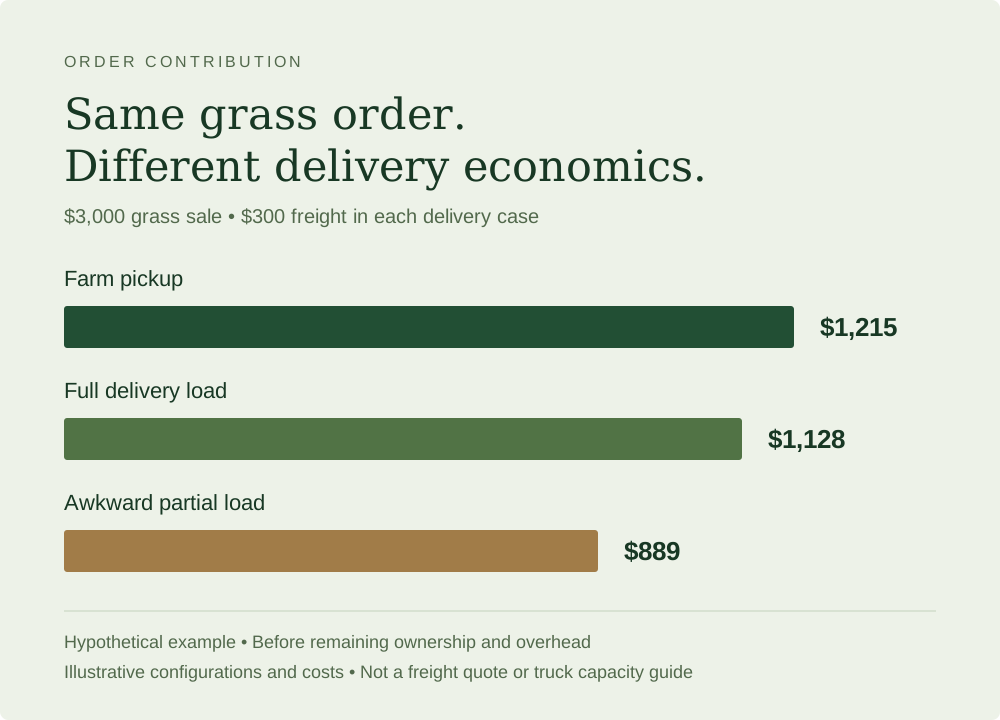
- In the hypothetical example, a $300 delivery charge leaves $87 less contribution on the full load and $326 less on the awkward partial than pickup.
- Reconcile route totals, avoid counting costs twice, and check whether delivery also supports annual equipment ownership and overhead.
A sod delivery makes money when the grass sale and delivery charge leave enough after the costs of the order, the entire trip, and the problems that follow it. Fuel is only one part of that calculation. Loading, driver time, waiting, unloading, empty return miles, claims, redelivery, and collection work can consume the apparent freight margin.
I would start with one completed order and follow it from the field to the final payment. Compare what the farm would retain if the customer picked up the same grass. Then ask whether delivery earned enough to justify the extra work and the capacity it used.
Separate order contribution from farm profit
Order contribution is the revenue left after the costs assigned to fulfilling that order. Here, that includes attributable grass production and harvest costs, loading, transport, service work, and a planning allowance for losses. It is a management calculation, not a substitute for the farm’s income statement.
That remaining money still has to support costs outside the calculation: equipment ownership, office overhead, land costs, management, and other obligations. A positive contribution does not establish that the delivery fleet or the whole farm is profitable.
Use two views:
- The next-order decision: What revenue and costs change if we accept this delivery instead of pickup, a different route, or no order?
- The ongoing service decision: Does the season’s delivery contribution also cover the trucks, trailers, unloading equipment, insurance, and support capacity required to offer it?
This follows the logic of Iowa State’s partial budgeting guidance: compare the income and costs that change. For the longer view, distinguish operating costs from ownership costs, as Mississippi State’s machinery cost framework does. Use your equipment records; its agricultural machinery examples are not sod freight rates.
A truck that is already paid for still has wear, repairs, insurance, and eventual replacement needs. An annual insurance bill may not change when you add one route, but it belongs in the decision to keep offering delivery.
Use the production cost worksheet for the farm-gate cost analysis that sits alongside this delivery calculation.
Compare the same grass order three ways
The following illustration is entirely hypothetical. It is not a market quote, an industry margin, a recommended delivery fee, or a statement of truck capacity.
Assume one customer orders 6,000 square feet at $0.50 per square foot, producing $3,000 of grass revenue. Attributable production and harvest cost is assumed to be $0.28 per square foot, or $1,680, before loading. That leaves $1,320 before fulfillment costs.
The farm can serve that order three ways:
- Farm pickup. The customer supplies suitable transport. The farm loads the order and handles the paperwork.
- A full delivery load. The order fills a suitable smaller vehicle configuration selected for this job. The route takes four paid driver hours and 120 total miles, including the return.
- An awkward partial load. The same order leaves on a larger, more expensive configuration after a planned companion order falls away. It still travels 120 total miles, but consumes six driver hours because of scheduling and site delays.
“Full” and “partial” describe these assumed configurations. They do not imply a standard number of pallets or square feet per truck. Actual payload, equipment carried, axle loading, securement, and route restrictions must be checked.
| Per-order item | Farm pickup | Full delivery load | Awkward partial load |
|---|---|---|---|
| Grass revenue | $3,000 | $3,000 | $3,000 |
| Delivery revenue | $0 | $300 | $300 |
| Total revenue | $3,000 | $3,300 | $3,300 |
| Production and harvest | $1,680 | $1,680 | $1,680 |
| Farm loading labor and loader operation | $60 | $60 | $60 |
| Driver labor | $0 | $160 | $240 |
| Truck operating cost | $0 | $132 | $186 |
| Site unloading equipment operation | $0 | $30 | $45 |
| Dispatch and service administration | $20 | $35 | $55 |
| Billing and collection work | $10 | $30 | $45 |
| Expected claim and handling loss allowance | $15 | $45 | $100 |
| Total assigned costs | $1,785 | $2,172 | $2,411 |
| Order contribution before remaining overhead and ownership costs | $1,215 | $1,128 | $889 |
Driver labor is assumed at $40 per paid hour, including the employer costs assigned to it. Four or six hours include loading attendance, travel, waiting, unloading attendance, and return work. Farm loading covers a separate loader operator and loader; it does not charge the driver twice.
Truck operation is $1.10 per total mile for the fitted vehicle and $1.55 for the larger configuration: $132 and $186. Those invented allowances cover fuel, including assumed idle use, tires, and attributable maintenance. They exclude driver labor, unloading equipment, and fixed ownership costs. Replace them with your own records. EIA’s regional weekly diesel series can provide a dated fuel reference, but it cannot price a route.
The three columns assume the same grass and payment terms. Different administration, collections, and loss allowances represent assumed service complexity, not an inherent defect of delivered orders. Refundable pallet deposits and sales tax are excluded; actual pallet damage or unrecovered balances need separate treatment.
What the example tells you
The $300 delivery charge does not preserve the pickup contribution. Relative to pickup, the full-load service adds $387 of assigned costs, leaving $87 less contribution. The awkward partial adds $626, leaving $326 less.
To equal pickup under these assumptions, the delivery charges would have to be $387 and $626, before any additional ownership allocation or desired reward for scarce capacity. If those charges are unrealistic for the customer, change the service plan: a different date, compatible route, vehicle, carrier, or pickup option may work better.
That does not automatically make delivery the wrong choice. If the customer will only buy delivered grass, the relevant alternative may be no sale. Both delivery cases still contribute something toward remaining costs. But compare that opportunity with other orders the same truck, driver, loader, or harvest window could serve. Do not add a theoretical lost order to costs unless it was a credible alternative.
Count the whole route and every stop
A delivery log should record loading start and finish, farm departure, site arrival, unloading start and finish, site departure, and return availability. Separate active work from waiting so you know what to fix. Price the time even when the contract does not let you bill for it.
The U.S. DOT inspector general’s 2018 detention report distinguishes total facility time from detention and explains the limits of the available trucking data. It is older national research, not a sod delivery benchmark. Its useful lesson here is to measure the actual event instead of treating a carrier’s billable waiting threshold as free operating time.
Include empty positioning and return miles. If a truck unloads grass and then collects pallets, returns rejected product, or moves to another field, record that work. A return trip is not free because the outbound delivery has already been invoiced.
For a combined route, build a route total first. Then assign stop-specific costs directly and distribute shared travel costs using a consistent method, such as distance and time. Check that all assigned order costs sum back to the route total.
An add-on stop needs two tests: whether it covers its added miles, time, and risk today, and whether the route as a whole covers its ongoing costs. Giving every order only its incremental detour can leave the base route unpaid. Charging the entire route to every stop creates the opposite error.
A partial load needs a plan before harvest
Unused deck space is not the same as usable capacity. A compatible companion order needs the right harvest timing, product, destination, unloading arrangement, delivery window, and legal loading plan.
Federal Highway Administration guidance explains why axle groups and spacing matter alongside gross weight on the Interstate System. State and local routes need their own checks. FMCSA’s cargo securement rules also make securement part of the loading job. Neither source supplies a universal pallets-per-truck figure.
Before accepting an awkward partial, I would resolve:
- Can it travel on an existing route without jeopardizing the earlier customer’s window?
- Is a smaller suitable vehicle or an outside carrier actually available at a confirmed cost?
- Who pays if the companion order cancels after harvest or dispatch?
- Does the receiver have the access, unloading equipment, operator, and prepared installation area promised?
- Is a quoted minimum delivery charge enough for the actual service being promised?
For hired freight, use the complete carrier quote and final invoice, including applicable waiting, unloading, fuel adjustments, and return or redelivery charges. Do not also deduct your own truck and driver costs for the same service. The farm may still incur loading, dispatch, claims, and collection work that the carrier invoice does not cover.
Put rejected loads and redelivery into the numbers
Sod quality risk belongs in dispatch planning. An Oklahoma State study published in 2025 examined storage time, heating, handling, and establishment in a 2023 Oklahoma trial. Conditions, cultivar, and storage duration affected outcomes; the bermudagrass and zoysiagrass were also harvested in different formats. That study cannot establish one commercial shelf life for every sod order.
Coordinate harvest, loading, delivery, and installation. Virginia Cooperative Extension’s sod guidance supports advance coordination, suitable transport, and prompt installation. A short drive can still produce a long delay if the site is not ready.
Use a planning allowance for claims only when you can explain it. As a separate hypothetical calculation, a 2% chance of an incident costing the farm $1,500 produces a $30 expected loss per comparable order. That is an illustration of probability multiplied by loss, not a recommended rejection rate. Thin records call for a range and a stress case.
Then examine a specific failure. Suppose 1,000 square feet of the example’s full-load order requires an uncharged replacement delivery. Its additional truck and driver expense is $300, replacement grass costs $280 to produce and harvest, extra loading and unloading cost $60, and administration costs $40. There is no refund, further sale, salvage recovery, or reimbursement in this assumption.
The incident costs $680. Replacing the original $45 planning allowance with that actual loss changes contribution from $1,128 to $493: $1,128 + $45 − $680. Subtracting both the allowance and the full incident would count the same risk twice.
A refund case is different. Reduce revenue for the actual credit and record actual return, disposal, or replacement costs as applicable. Do not assume returned sod is saleable. Document any salvage proceeds and the costs of recovering them. A carrier reimbursement belongs in the result when supported; it is not guaranteed merely because a claim was submitted.
Close the order through collection
Proof of delivery should identify quantity, variety, recipient acknowledgment, timing, exceptions, and relevant photographs. It supports billing and investigation; a signature alone does not settle every quality dispute.
Track whether the invoice was issued correctly, when it was due, when it was paid, what was credited, and how much staff time went into resolving it. A delivery surcharge that is later waived never became retained freight revenue.
Separate a slow payment from a credit loss. Iowa State’s cash-to-accrual explanation distinguishes earned income and receivables from cash timing. For this worksheet, use the actual net invoice, record collection costs, and show uncertain recovery explicitly. Update estimates when the outcome is known.
If you separately model the cost of financing a receivable, state the balance, time, and assumed rate. Do not treat the entire unpaid invoice as both an expected loss and a financing expense. Keep this order review connected to accounting without confusing it with bank cash.
Compare repeat orders in the customer profitability scorecard before deciding that a high-volume account deserves better delivery terms.
Use this route and order worksheet
Copy these fields into a spreadsheet or dispatch report. Complete one estimate before promising the service, then reconcile it after payment and claims resolution.
| Worksheet line | Record or calculation |
|---|---|
| Order identity | Customer, site, variety, square feet, harvest date, load and route IDs |
| Net revenue | Grass plus freight and earned service charges, less discounts and actual credits |
| Grass cost | Attributable production and harvest cost on a consistent basis; purchased sod at its actual cost |
| Farm loading | Separate worker time, loader operation, rehandling, packaging, and actual pallet losses |
| Own transport | Total miles × operating cost per mile; all driver hours × assigned hourly labor cost; unloading equipment cost |
| Hired transport | Complete carrier cost instead of the own-transport costs it replaces |
| Service and collection | Dispatch, changes, site coordination, documentation, billing, and collection work |
| Loss treatment | Expected allowance while planning; actual unrecovered claim and failure costs at closeout, excluding credits already deducted from net revenue |
| Order contribution | Net revenue less the assigned costs above |
| Service comparison | Delivery contribution less pickup contribution, or compare with another credible alternative |
| Capacity and ownership check | Hours consumed, competing work displaced, and delivery contribution available for annual ownership and overhead |
Keep cost definitions beside the worksheet. If grass cost already includes loading, move it out before adding loading again. If a truck rate includes driver pay or fixed insurance, do not charge those items a second time. Reconcile monthly route results to payroll, fuel, repairs, carrier bills, invoices, and credits.
Carry the expected payment dates into the working capital forecast so contribution and available cash remain separate.
Common questions about sod delivery profit
How far should a sod farm deliver?
There is no universal profitable radius. Test total miles, elapsed time, legal operation, handling conditions, unloading readiness, price, and competing work. A nearby difficult stop can retain less than a well-planned longer route.
Does farm pickup eliminate handling risk?
No. The farm still loads and documents the order. Confirm a suitable customer vehicle and communicate pickup and installation expectations. Customer pickup changes who performs transport; it does not remove the farm’s own loading costs or automatically resolve responsibility for a later claim.
Can agricultural trucking exemptions make the route work?
They may change which hours-of-service requirements apply, but they do not remove operating costs. FMCSA’s 2020 sod determination recognized sod as an agricultural commodity for the relevant exception. The agency’s agriculture guidance explains conditions; its general hours-of-service summary describes the broader framework. Have the carrier verify the rules for the actual operation. An exemption boundary is not a quality limit or a pricing rule.
What should I change first?
Review a recent pickup, a well-filled delivery, and an awkward partial. Reconstruct the costs through final payment. Choose the largest preventable leak—waiting, unpriced rehandling, failed route pairing, unclear unloading, or unresolved credits—and change the quote or dispatch process that caused it.
Delivery records also help explain the operating business to a future buyer. If a sale is on your horizon, start a confidential conversation about your sod farm. Clear order economics make that conversation more useful.
Sources
The linked sources support the budgeting method, cost categories, transport constraints, cash distinction, and quality considerations. All prices, rates, capacities described by configuration, and financial outcomes in the worked examples are hypothetical.
- Iowa State Extension: partial budgeting and cash-to-accrual farm income.
- Mississippi State Extension: machinery ownership and operating costs.
- U.S. EIA: weekly regional diesel prices.
- U.S. DOT OIG: 2018 driver detention report.
- FHWA: bridge and axle weights. FMCSA: securement, hours of service, sod determination, and agriculture exemptions.
- Oklahoma State Extension: sod storage research. Virginia Cooperative Extension: sod handling and installation.