By David Lapham · Published
At a glance
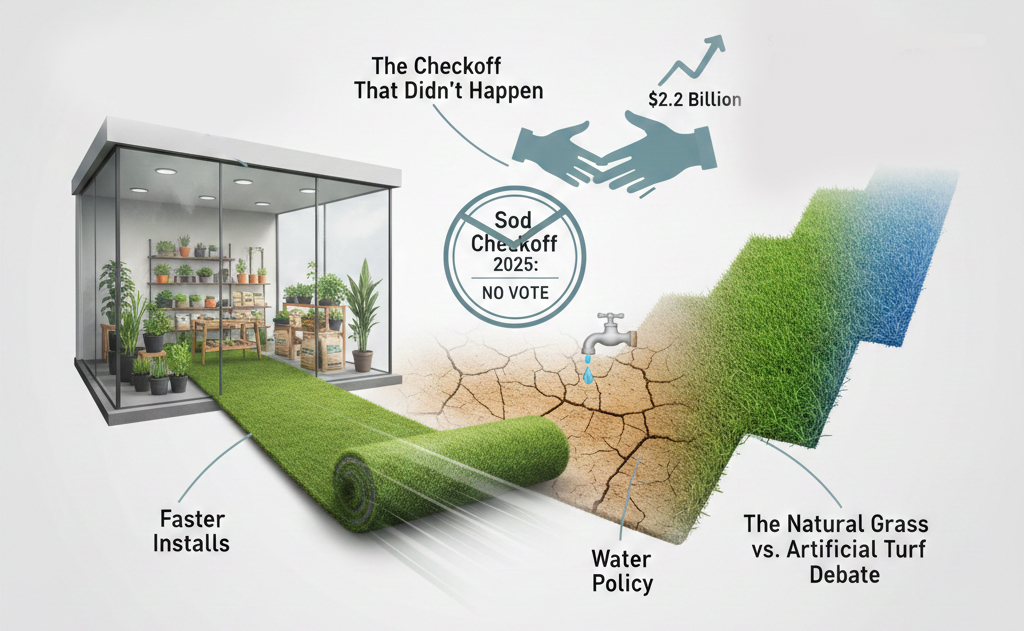
- U.S. sod remains a large category: more than $2.2 billion in value, 1,447 farms, and 376,227 acres.
- Q4 2025 USDA market commentary points to contractor-led demand with retail as a growing secondary channel.
- Retail diversification and installation speed are becoming core go-to-market strategies.
- Producers rejected the 2025 national promotion order referendum, signaling governance and trust friction.
- Water policy and nonfunctional turf rules are reshaping demand by region and use case.
If you have not looked closely at sod recently, the 2026 storyline is clearer than it first appears:
- growers are moving closer to end customers,
- installers are selling speed as part of the product, and
- the industry rejected a national promotion-and-research checkoff model right as water policy tightens in key regions.
Below is a market audit with implications for growers, installers, developers and HOAs, and investors.
The Market Snapshot: What the Numbers Show
U.S. Scale
The USDA promotion order text summarizes the category at:
- More than $2.2 billion in value (2022 Census of Agriculture)
- 1,447 farms across 376,227 acres
- Active sod farms in at least 49 states
Source: Natural Grass Sod Promotion, Research, and Information Order (Federal Register)
Q4 2025 Production Signal (Published January 21, 2026)
USDA AMS Market News reported for October 1 to December 31, 2025:
- 30,719 (1K sq ft) total volume
- 13,463 cool-season
- 17,256 warm-season
Important context in the same report:
- The sample was 11 producers, so this is directional market intelligence, not a full census.
- 64% reported supplies at least adequate; 36% reported limited supplies.
- 64% planned to maintain acreage; 36% planned to increase acreage.
- Producer-estimated end use: landscape contractors (47%), athletic fields and golf (24%), retail and garden centers (11%), developers and builders (8%), homeowners (6%).
Source: USDA AMS National Quarterly Sod Report (Q4 2025)
Trend 1: Retail Diversification
A notable 2026 move: Council Growers Sod opened a retail nursery in Ruskin, Florida. The offering extends beyond pallets, including plants, fruit trees, herbs, vegetable starts, soils, mulch, and sod by the piece.
Source: The Observer News (February 12, 2026)
Why Operators Are Doing This
- Capture more margin per transaction through bundled products.
- Reduce seasonal volatility by adding plant and retail sales.
- Serve contractor convenience with one-stop purchasing.
- Build a stronger local brand than commodity pallet pricing alone.
Where It Can Break Down
- More SKU and inventory complexity.
- New staffing model and customer-service demands.
- Potential conflict with legacy wholesale channels.
Takeaway: Retail can be a margin unlock, but only with disciplined operations and the right local traffic patterns.
Trend 2: Speed as a Product
Installers increasingly market rapid turnaround. One public example is Keathley Landscaping, which advertises most installs in 1 to 3 days, depending on project scope.
Source: Keathley Landscaping Sod Installation
Why Speed Is Winning Attention
- Homeowners want immediate visual transformation.
- Contractors increase crew utilization with faster cycle times.
- Developers and listing timelines reward quick curb-appeal upgrades.
Quality Guardrails
Speed only works if installation fundamentals remain intact:
- Site prep and grading
- Irrigation readiness
- Correct laying and rolling
- Post-install watering and care protocol
Takeaway: The durable competitive edge is not just "fast." It is fast with reliable establishment.
Trend 3: The Checkoff Vote That Failed
In a January 13 to February 11, 2025 referendum, producers rejected the proposed Natural Grass Sod Promotion, Research, and Information Order. USDA announced the result on May 6, 2025, with 63.51% voting No, and later withdrew the rule.
Sources:
What the "No" Likely Signals
- Fee resistance and governance skepticism among producers.
- Uneven confidence that benefits would be distributed fairly.
- Ongoing need for category-level research and messaging, but low consensus on mandatory funding design.
Takeaway: The failed vote was likely about trust and governance structure, not a blanket rejection of promotion or research needs.
Water Policy Is Now a Demand-Shaping Variable
Policy pressure is increasingly location-specific and material:
- Colorado SB24-005 limits nonfunctional turf and certain artificial turf uses in defined contexts beginning January 1, 2026 (with exemptions such as athletic fields).
- Colorado HB25-1113 expanded and clarified turf limits for new residential development contexts (signed May 20, 2025, effective August 6, 2025).
- California AB 1572 implementation targets potable-water irrigation of nonfunctional turf in covered property categories.
- In February 2026, Tampa Bay area drought response tightened watering restrictions to once weekly.
Sources:
- Colorado SB24-005
- Colorado HB25-1113
- AB 1572 overview (Pomona)
- Axios Tampa Bay drought restrictions (February 10, 2026)
Takeaway: Water policy is not one national trend. It is a local demand shaper that can redirect product mix toward functional-use, drought-aware turf programs.
Natural Grass vs Synthetic Turf Is a Real Budget Battle
Competition is increasingly across surface solutions, not just within sod providers.
Concerns Raised About Synthetic Turf
- Peer-reviewed literature has examined environmental risks from micro and nanoplastic breakdown.
- Public discourse has elevated PFAS exposure concerns in some synthetic systems.
Sources:
- Environmental Pollution study on breakdown nanoplastics
- The Guardian report on PFAS concern visibility
Why Synthetic Still Wins Some RFPs
- Lower irrigation demand
- Lower mowing inputs
- Uniform appearance in targeted use cases
Takeaway: Market share outcomes will depend on use-case fit, lifecycle economics, and public perception, not one universal winner.
Practical Implications by Stakeholder
For Growers
- Diversification can raise margin and improve customer stickiness.
- Contractor channels remain central in many markets.
- Policy-aware product strategy is now core risk management.
For Installers
- Sell both transformation speed and establishment success.
- Include irrigation and care plans as part of the install package.
- Protect margin by reducing callbacks.
For Developers and HOAs
- Expect more scrutiny on ornamental vs functional turf.
- Lifecycle reliability under local watering rules matters more than the lowest upfront bid.
For Investors
Durable operators typically combine:
- strong local logistics,
- stable contractor relationships,
- policy-aligned product and irrigation expertise, and
- optionality across retail, installs, and related landscape products.
2026 Watch List
To monitor direction in real time, track:
- USDA quarterly sod reports for demand and supply commentary.
- Local drought and watering-rule updates.
- State-level nonfunctional turf policy changes.
- Any post-referendum shift toward voluntary industry research and promotion funding.
Bottom Line
The visible trends in 2026 - retail expansion, speed-focused installs, and industry policy friction - are all responses to the same pressures:
- commoditization pressure,
- labor and timeline sensitivity,
- water-policy and sustainability scrutiny, and
- substitute competition.
Sod remains a significant U.S. category, but winning strategies are becoming more localized, operationally disciplined, and policy-aware.
Want a regional breakdown next? A Florida vs Texas vs Colorado playbook can clarify what wins by market profile and regulation.