By David Lapham · Published
At a glance
- Separate deeded, controlled, field, irrigated, planted, and currently harvestable acres.
- A dated field schedule should explain growth stage, quality, irrigation, and access.
- Convert cuttable area to expected accepted output before subtracting customer commitments.
- Verify annual capacity with block history and actual harvest records; planted acres are not today’s saleable inventory.
A sod farm’s advertised acreage does not tell you how much grass it can sell. Start with the land the business actually controls, remove areas outside the production footprint, identify fields with dependable irrigation, and then separate planted crop by growth stage, quality, and harvest access. Currently harvestable acreage is a dated field assessment. It can be a smaller number than planted acreage, and it still needs a cutting-loss and order-commitment check.
There is no sound universal percentage to apply to every farm. A property with more gross acres can have less usable crop than a smaller operation. The useful answer is a reconciled map and field schedule, with a clear definition beside every acreage total.
Give each acreage number a job
“Productive acres” can mean several things. Before comparing farms, ask the seller to state which of these numbers the listing uses.
- Gross deeded acreage: the entire owned tract, including support areas and land that may not grow sod.
- Controlled acreage: land available to this operating business under the ownership and lease arrangements being reviewed. Add leased-in land and remove owned land leased to someone else or otherwise unavailable to the operation.
- Net production footprint: mapped field area after removing roads, yards, ponds, drainage corridors, and other excluded areas. It can include idle or unplanted fields.
- Irrigated field footprint: the portion of that field area the installed system can reliably serve under the operating plan. A pipe crossing a field is insufficient evidence.
- Planted acreage: land carrying the sod crop, including immature grass and regrowth. State whether a record includes recently cut blocks that are recovering.
- Harvestable acreage: crop inspected as mature and suitable for the intended product, with access and field conditions allowing harvest during a stated period.
These are working definitions for a buyer’s review, not substitutes for the definitions in a survey, lease, permit, or reporting form. USDA’s 2024 horticulture questionnaire separately asks for sod area used for production and area harvested. Neither annual number is an inventory count for today.
Keep the ownership schedule beside the production schedule. Leased ground may support the business’s output without being part of the real estate offered for sale. Conversely, deeded land leased to another operator may belong in the property package while contributing no crop to this business.
A hypothetical 500 acre farm becomes 80 cuttable acres today
The following example is invented to show the reconciliation. It describes no actual property, typical efficiency ratio, crop yield, or production forecast. Assume every area is measured on a consistent basis and all categories within each step are mutually exclusive.
The seller owns 500 acres, farms another 100 under lease, and leases 40 of the owned acres to a neighbor. The operating business therefore controls 560 acres: 500 + 100 − 40. Whether those leases continue after a purchase is a separate document question.
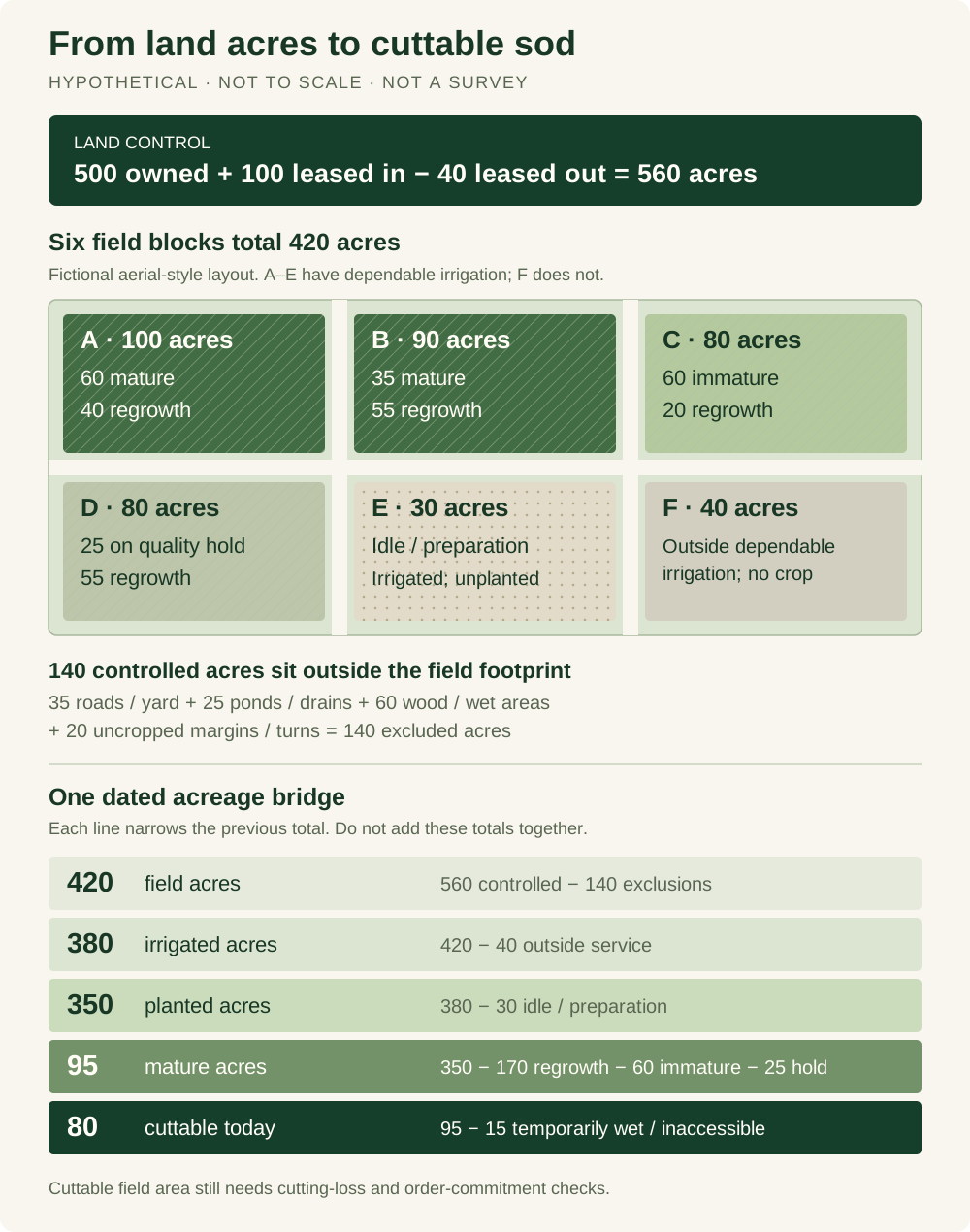
Illustration only. Shapes are not to scale, locations are fictional, and the graphic is not a survey, wetlands determination, or irrigation design. The tables provide the same quantities in text.
First reconcile the land and field footprint
| Step | Change in acres | Acres remaining |
|---|---|---|
| Owned tract | Starting total | 500 |
| Add leased-in land | +100 | 600 |
| Remove owned land leased to another operator | −40 | 560 controlled |
| Roads, loading yard, buildings, and access lanes | −35 | 525 |
| Ponds and drainage corridors | −25 | 500 |
| Woodland and wet areas excluded from this production plan | −60 | 440 |
| Uncropped field margins and turning areas | −20 | 420 field footprint |
| Fields outside dependable irrigation service | −40 | 380 irrigated footprint |
| Irrigated area idle or being prepared | −30 | 350 planted |
Count each exclusion once. A ditch through a wet area cannot appear in both the drainage deduction and the wet-area deduction. Where a field polygon already excludes turning areas, do not subtract them again.
The 60 wet and wooded acres are excluded by assumption; this example makes no finding about their regulatory status or potential future use. Likewise, the 40 acres outside dependable irrigation are not declared permanently unusable. They simply contribute nothing to this example’s irrigated crop plan until the gap is resolved.
Then inspect the crop inside those fields
The same example has six mapped blocks. The numbers below are field acres, before any cutting allowance. All A–E acreage has dependable irrigation under the example’s assumptions; F does not.
| Block | Field acres | Status at the inspection date |
|---|---|---|
| A | 100 | 60 mature; 40 in regrowth |
| B | 90 | 35 mature; 55 in regrowth |
| C | 80 | 60 immature; 20 in regrowth |
| D | 80 | 25 on quality hold; 55 in regrowth |
| E | 30 | Idle or being prepared; no planted crop |
| F | 40 | Outside dependable irrigation; no crop counted |
| Total | 420 | 350 planted; 30 idle irrigated; 40 outside irrigation |
The planted total reconciles as 95 mature + 170 regrowth + 60 immature + 25 on quality hold = 350 acres. Regrowth and immature fields are part of the production cycle. They are not available for immediate cutting. The quality hold remains separate until inspection supports a change.
Mississippi State Extension notes that fields can be too wet to harvest. Assume 15 of the 95 mature acres cannot be reached or harvested under today’s wet conditions. That leaves 80 acres cuttable today. The farm did not lose 15 acres of land; its current harvest access changed. Record the reason and reassessment date rather than quietly deleting the area from the map.
Convert cuttable area into a planning quantity
Assume all quantities in this availability calculation meet the same variety, product specification, and order window. For this illustration, allow another 5 acre-equivalents for retained strips and expected cutting or quality losses within the 80 acres. This assumption is deliberately expressed as area so the calculation stays visible. It is not an industry loss rate.
The estimated accepted output is therefore 75 acre-equivalents × 43,560 square feet = 3,267,000 square feet. The 5 acre-equivalents have not already been removed as roads, margins, wet ground, or quality-hold acreage. Actual accepted harvest quantities must replace this estimate as cutting proceeds.
Suppose existing confirmed orders reserve 871,200 square feet, equal to 20 acre-equivalents of accepted output. The uncommitted planning balance is 2,395,800 square feet, or 55 acre-equivalents. Reservations reduce what can be promised to additional customers; they do not reduce the mapped field acreage.
The concise description is now useful: 500 deeded acres, 560 controlled, 350 planted, 80 cuttable today, and an estimated 2.40 million square feet uncommitted after the stated allowances and reservations. Every number has a different job.
Green grass is not enough to establish readiness
Aerial imagery can identify field shapes and visible changes. It cannot establish whether sod will lift and handle properly, meet the buyer’s quality requirements, or survive the intended handling and installation process.
The University of Kentucky’s Turfgrass Sod Production explains that sod is ready for harvest when it is mature enough to remain intact during cutting and handling. That supports checking the mat itself rather than assigning readiness from color or an acreage label. Kentucky production guidance should not be used to impose a Florida harvest calendar.
Keep these checks with the field record:
- Confirm the species and cultivar, planting or last-harvest date, and actual stage of recovery.
- Inspect coverage, mat strength, weeds, pests, disease, damage, and any customer-specific requirement.
- Identify partial cuts, retained strips, irregular edges, and patches excluded from accepted harvest.
- Check soil moisture, field access, and whether the available equipment can cut and remove the product under current conditions.
- Record who inspected, when, what was accepted, and what remains conditional.
Virginia Tech’s sod source selection guidance treats quality as more than appearance, including weeds, pests, and sod strength. Its discussion of Virginia certification also illustrates the role of field and preharvest inspections in that program. Verify any certification claim for the actual crop and applicable program; do not infer it from appearance or extend it to an entire farm without records.
Irrigated acreage needs an operating test
Separate three questions: where can the system reach, what can it deliver under demanding conditions, and what water use is authorized?
Ask to see coverage by block, pump and system condition, operating pressures and flow records where available, scheduling constraints, and maintenance history. A coverage map may show 380 acres while a failed pump, inadequate delivery at the far end, or simultaneous demand prevents the planned service. The NRCS Irrigation Guide, issued in 1997, explains system capacity in relation to crop demand, rainfall, and groundwater contributions. Use that principle to frame a current field evaluation, not its old example rates as a site design. Retain any service gap as an unresolved operating constraint.
UF/IFAS’s fertility guidance for sod production describes Florida’s varied growing conditions and management differences associated with soils, grasses, and growth objectives. Florida’s 2024 sod BMP manual addresses irrigation management, drainage, and records. These sources support a stage-specific review; they do not establish the pumping capacity or reliable output of a particular farm.
For a Florida property, review the actual authorization with the governing district. As one district-specific example, the South Florida Water Management District describes permits that authorize specified withdrawals, impose limits, and expire unless renewed. An irrigated-acre count does not establish permission to expand water use. Match the source, location, quantities, conditions, and term to the proposed operation.
For a Florida farm, use the water permit diligence guide to investigate the authorization as well as physical capacity.
Annual output needs a separate capacity calculation
Today’s harvestable crop is a snapshot. Annual production is a flow through planting, regrowth, harvest, and accepted sales.
Do not multiply all planted acres by an assumed number of annual turns. Seeded and vegetatively propagated systems differ, and growth depends on species, season, management, and field conditions. The USDA’s turfgrass sod feasibility report, published in 1995, describes these production differences and the acreage left behind in strip harvesting. Its old prices, industry structure, and timing examples are unsuitable for a current farm forecast.
I would build the forecast from the farm’s own block history. For each variety, compare actual harvest dates, area cut, accepted square feet, time to the next harvest, downtime, and remaining crop. Use at least a full relevant growing cycle, and more history where available to expose seasonality and interruptions.
Then test the bottlenecks. Can irrigation support establishment and mature fields together? Can the crew, harvester, loading area, and transport arrangements handle the proposed weekly output? Is there demand for that variety when it becomes ready? A field can be biologically ready while the business lacks the capacity or orders to turn it into collected sales.
Keep bought-in sod separate. Reselling another producer’s crop can increase sales without increasing this farm’s harvested acreage. Likewise, credits and rejected product can reduce accepted sales without changing the original cut-area record. Reconcile those movements before using invoices to support a production claim.
The grass variety allocation guide extends this question into demand, field occupancy and the production calendar.
Verify the map against documents and actual cuts
Use one block ID in the map, crop schedule, irrigation records, and harvest tickets. Put a date on each layer. The USGS NAIP data dictionary distinguishes imagery acquisition date from the date an image entered the inventory. A recently opened map can contain an older photograph.
Start with the deed, survey, parcel information, and lease schedules to establish the acreage basis and rights being offered. Reconcile discrepancies rather than assuming the largest reported total is correct. Field polygons are management measurements; have boundary and title questions resolved through the appropriate transaction review.
Add soil, drainage, and environmental information as investigation layers. NRCS Web Soil Survey supports general farm planning and explains that some uses require onsite investigation. The Fish and Wildlife Service Wetlands Mapper uses a biological wetland definition and does not establish regulatory jurisdiction. A colored overlay alone should not become an automatic production deduction or permission to clear land.
Use this compact worksheet for each block:
| Record | What to enter or verify |
|---|---|
| Identity and control | Block ID, owned or leased status, area basis, access, and agreement reference |
| Geometry | Gross polygon, individually mapped exclusions, and net field acres |
| Water | Irrigation service area, observed constraints, and authorization reference |
| Crop | Species/cultivar, planted area, last planting or harvest, stage, and inspection date |
| Availability | Mature area, current access holds, cutting allowance, and accepted-output estimate |
| Commitments | Reserved square feet by product/date and remaining uncommitted estimate |
| Evidence | Dated photos, inspection notes, harvest tickets, accepted quantities, and unresolved differences |
After a partial harvest, update the remaining area and move the cut portion into its next crop stage. Release the related reservation when the actual shipment replaces it. Subtracting both the reservation and the completed shipment from the same availability balance would count the order twice.
The production cost worksheet uses those reconciled areas and saleable output to calculate unit cost.
Questions buyers and sellers should settle early
What percentage of a sod farm should be productive?
There is no defensible universal target. Compare farms using the same acreage definitions and explain support land, constraints, crop stages, and dates. A high planted percentage alone says little about dependable water, crop quality, or annual accepted output.
Does a recently harvested field still count as planted?
It can remain in the crop-production footprint when viable regrowth is being managed for another crop. Label it as regrowth and record the harvest date. Keep bare preparation ground separate, and do not treat regrowth as ready inventory.
Can irrigated acres be treated as guaranteed production?
No. Verify physical service, operating capacity, water authorization, crop condition, and field access. An irrigation footprint is one input to the production plan.
How much of the harvestable crop is available to a new customer?
Use the accepted-output estimate after stated losses, then deduct existing commitments for the same product and period. Check availability by variety; spare acreage of one grass cannot automatically fill an order for another.
What should a seller prepare before marketing the farm?
Prepare a dated acreage bridge, field map, crop-stage schedule, and harvest history that reconcile. Show leased acres and unresolved limitations plainly. The buyer should be able to trace the headline acreage to specific land, fields, crop, and actual output.
If you are looking for a sod farm, bring the acreage definitions and a current field schedule into the comparison. If you are preparing to sell, assembling those records is a useful first step toward explaining what the operation can actually produce.
Bring the acreage evidence into the broader buyer inspection checklist before advancing the offer.
Sources and further reading
The linked government and university materials support the definitions, agronomy, and verification steps above. Farm-specific quantities require current records and inspection.
- USDA NASS 2024 horticulture questionnaire, section 10: separate production-area and harvested-area reporting.
- University of Kentucky Turfgrass Sod Production and Virginia Tech sod source selection: production and quality considerations.
- UF/IFAS sod fertility and Florida sod BMP manual: crop stages, water management, and records.
- Mississippi State sod guidance, NRCS’s 1997 Irrigation Guide, and USDA’s 1995 turfgrass sod report: wet-field constraints, system-capacity principles, and historical production mechanics.
- SFWMD water-use permits, NRCS soil information, FWS Wetlands Mapper, and USGS imagery metadata: checks and limits when reviewing fields.