By David Lapham · Published
At a glance
- Build demand by named cultivar and requested month, including lost orders and accepted substitutions.
- Convert saleable square feet into occupied acres using the farm’s own production records.
- Test slower sales and slower production together; annual acreage can balance while monthly availability fails.
- Confirm propagation permission, brand use, certification, and traceability before planting.
Choose a sod farm’s grass variety mix by matching documented customer demand to the acres, growing time, field conditions, and permissions needed to supply it. Start with the varieties customers actually specify and the months they buy. Then test whether the farm can produce saleable sod on time, keep each cultivar identifiable, and earn enough from the land it occupies.
A grass with a higher selling price can still be a poor acreage decision if it ties up a field longer, misses the customer’s installation window, or requires production controls the farm cannot reliably maintain. I would make the planting plan from a field-by-field sales and production schedule, then test a slower-sales case before converting established acreage.
Start with the product your customer is buying
A species is a broad grass category, such as St. Augustinegrass or bermudagrass. A cultivar is a selected variety within that category. A trade name can be different from the cultivar’s formal name. Those distinctions matter when a landscape plan, sports-field specification, or repeat customer requires a particular product.
For example, the Florida Foundation Seed Producers listing identifies CitraBlue® St. Augustinegrass as cultivar ‘FSA1602’. Record both names in the product file so the planting material, field inventory, license, and customer order refer to the same grass. FFSP’s CitraBlue listing
Here, “variety mix” means the farm’s acreage allocation among separately identified products. It does not mean mixing vegetatively propagated cultivars in one field. A specified seeded blend for a cool-season market is a separate product with its own composition and quality requirements.
Build a demand record in square feet by product and requested month. Distinguish completed sales, firm orders, recurring purchases without commitments, quoted projects, and general inquiries. Record lost orders and their reasons. Sales alone can understate demand when the farm ran out; inquiries can overstate it when the same project appears through several bidders.
Ask customers what substitution they would accept. “Bermuda” on an old invoice does not prove that any bermudagrass will satisfy the next job. Confirm cultivar, certification, format, delivery timing, and any project approval before treating products as interchangeable.
Use regional surveys as context for local demand
The Florida Sod Inventory and Pricing Report—2025, published in November 2025, came from a survey sent to 50 Turfgrass Producers of Florida members in January 2025. Twenty-six responded. Its tables report 2024 production acreage, prices, and customer markets; its inventory outlook covered the following six months. Landscape contractors were the largest reported customer segment. This is useful historical context, not a census of every Florida farm or a forecast of your present customers. UF/IFAS report
Georgia’s 2025 Sod Producers Report surveyed 23 producers about spring and early summer 2025. Among the relevant growers, 76% reported adequate to excellent bermudagrass inventory and 81% adequate to excellent zoysiagrass inventory. These were producer expectations against anticipated demand, not measured shares of statewide demand. University of Georgia report
For a more recent example, NC State’s March 2026 survey had 21 respondents. Among 15 zoysiagrass growers, 20% anticipated shortages. That tells an owner to investigate availability in the relevant market; it does not establish a local sales opportunity or a preferred cultivar. NC State report, May 2026
Use reports to frame questions for customers and nearby market participants. Ask which specifications are changing, which projects have funding, and when sod will be needed. The farm’s own records should determine acreage.
The customer profitability scorecard helps test the quality and service demands of the sales behind that demand.
Put every candidate through the same decision matrix
Use this matrix for each named product and each proposed field. A missing production right or unsuitable field should stop that proposal even when the sales outlook looks attractive. Other uncertainties may justify a smaller trial or staged planting.
| Decision | Evidence to collect | Effect on the acreage plan |
|---|---|---|
| Customer demand | Sales, lost orders, named specifications, accepted substitutions, customer confirmations | Separate supported volume from speculative volume |
| Regional and field fit | Local Extension guidance, soil tests, drainage, irrigation performance, pest history, climate | Assign the product only to suitable blocks |
| Production requirements | Farm records for establishment, regrowth, mowing, weed control, saleable yield, cutting strength | Estimate usable output per occupied acre and the work required |
| Sales timing | Requested delivery months against realistic field-ready dates | Stagger blocks; identify seasonal shortages |
| Inventory | Ready, committed, immature, damaged, and otherwise restricted sod by cultivar | Test new planting against existing stock and scheduled depletion |
| Licensing and identity | Current agreement, authorized planting source, certification and traceability requirements | Confirm permission, costs, inspections, and feasible separation |
| Economics and capacity | Remaining costs, expected net receipts, months of land use, labor and equipment peaks | Compare alternatives over the same period and resource limits |
Do not reduce the whole decision to a weighted score that lets a strong sales rating cancel an unresolved license or water constraint. First establish that the proposal can be carried out. Then compare the feasible alternatives.
Separate lawn performance from farm production performance
A customer wants grass that suits the installation site. The producer also needs grass that establishes predictably, remains clean, lifts satisfactorily, and sells within the planned window. A homeowner’s maintenance recommendation cannot establish a farm’s harvest cycle.
Species labels alone are too broad. UF/IFAS describes substantial differences among St. Augustinegrass cultivars. Its guidance identifies Floratam as having relatively poor shade and cold tolerance compared with other St. Augustinegrass cultivars. A familiar name is therefore no substitute for checking the actual end-use conditions. UF/IFAS St. Augustinegrass guidance
The same care applies to zoysiagrass. UF/IFAS distinguishes species and cultivars with differing characteristics. A 2025 research review also identifies slower growth as a sod-production disadvantage relative to bermudagrass and highlights gaps in production research. Neither source establishes the harvest interval for a particular field. UF/IFAS zoysiagrass guidance, Braun and colleagues, August 2025
Start the field assessment with soil conditions, drainage, water delivery, prior weeds, and the proposed management program. UF/IFAS’s sod-specific fertility publication explains that species, soil organic matter, and Florida production region affect nutrient planning. Use current soil tests and local advice to build the program; a lawn fertilizer schedule is not a production budget. Fertility Considerations for Sod Production, reviewed October 2025
Cool-season markets need their own plan. The University of Kentucky’s January 2019 sod profile discusses Kentucky bluegrass and tall fescue production, including blends or mixtures used for sod strength. That regional example illustrates why a Florida warm-season portfolio should not become a national prescription. Its old cost estimates are not current budgeting inputs. University of Kentucky crop profile
For a new cultivar, use a manageable, separately mapped trial. Record planting source, establishment date, inputs, quality problems, harvest performance, and actual customer acceptance. Expand after the production and sales evidence supports it.
Convert expected sales into occupied acres
Annual sales share and acreage share answer different questions. A slower product may need more acres to deliver a smaller share of the farm’s annual sales volume.
A useful first calculation is:
Required acres = planned annual saleable square feet ÷ expected annual saleable square feet per occupied acre.
Estimate the denominator from the farm’s records over a complete growing and selling cycle. It should reflect usable harvest yield, regrowth or replanting time, seasonal interruptions, quality losses, and any waiting period before the next crop. Do not count a loss twice by reducing both the measured output and the acreage again for that same loss.
A hypothetical 300 acre allocation
The following numbers are invented to demonstrate the method. They are not species yields, cultivar rankings, industry benchmarks, or a forecast. Assume the farm has 300 acres eligible for these products, after roads, drains, and other unusable areas have already been removed. Assume existing production is mature enough to support a continuing operation; this is not a first-year planting forecast.
For simplicity, assume each harvest yields 40,000 saleable square feet per occupied acre. Annualized harvest frequencies are 1.5 for A, 1.0 for B, and 0.75 for C. These are long-run planning averages across staggered blocks. They do not promise fractional harvests from a new field in a calendar year.
| Hypothetical product | Annual sales plan | Annual saleable output per acre | Required acres |
|---|---|---|---|
| A — core landscape cultivar | 7,200,000 sq ft | 60,000 sq ft | 120 |
| B — specified contract cultivar | 3,600,000 sq ft | 40,000 sq ft | 90 |
| C — specialty cultivar | 1,800,000 sq ft | 30,000 sq ft | 60 |
| Total commercial allocation | 12,600,000 sq ft | — | 270 |
| Uncommitted acreage | — | — | 30 |
Product C supplies about 14.3% of annual sales volume but occupies 22.2% of the 270 commercial acres. Product A supplies about 57.1% of volume on 44.4% of those acres. Allocating land in proportion to sales volume would underprovide C under these assumptions.
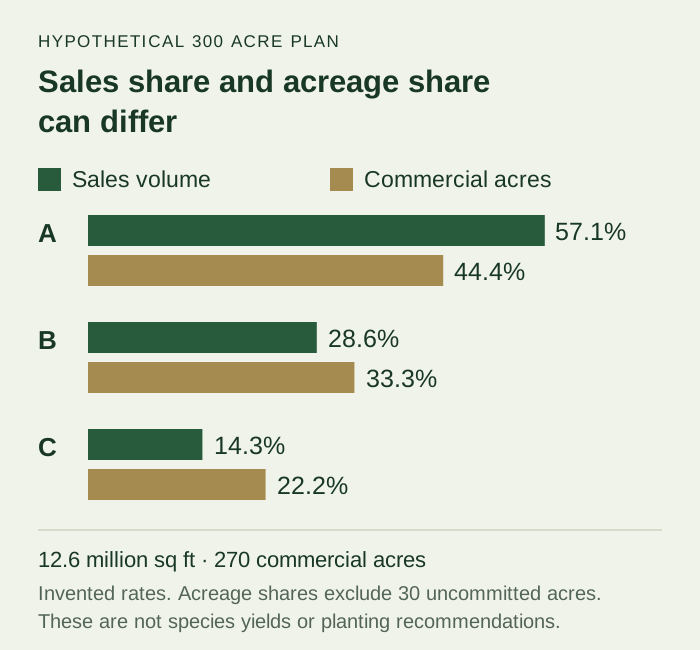
The remaining 30 acres provide planning flexibility. They are not 30 acres of ready inventory. Their use for preparation, rotation, trials, or future production must be scheduled, and those uses may make them temporarily unavailable.
Change the assumptions before changing the fields
Keep the same hypothetical output rates unless a row explicitly changes them.
| Alternative scenario | A acres | B acres | C acres | Total needed | Acres left from 300 |
|---|---|---|---|---|---|
| Base plan above | 120 | 90 | 60 | 270 | 30 |
| C demand rises to 2.7 million sq ft | 120 | 90 | 90 | 300 | 0 |
| A demand falls to 5.4 million sq ft | 90 | 90 | 60 | 240 | 60 |
| B annual output falls to 32,000 sq ft per acre | 120 | 112.5 | 60 | 292.5 | 7.5 |
| Higher C demand plus slower B production | 120 | 112.5 | 90 | 322.5 | −22.5 |
The combined case exceeds available acreage by 22.5 acres. The owner must change something: reduce commitments, obtain suitable additional production capacity, arrange verified outside supply, or change the product plan. Planting a different cultivar cannot create immediate replacement inventory.
In the lower-demand case, the calculation does not instruct the owner to destroy 30 acres of established A. First review ready inventory and commitments, then consider reducing future planting or changing blocks after harvest. Conversion costs, removal of the previous cultivar, and the time to the replacement crop belong in that decision.
Use the productive acreage reconciliation to check which fields can actually support the allocation.
Check the monthly inventory before promising annual volume
An annual plan can balance and still fail in April. For each cultivar, build a monthly schedule:
Opening ready inventory + newly ready farm-grown sod + purchased saleable sod − planned shipments − quality losses = closing ready inventory.
Keep units consistent. Treat immature fields as future availability with a supported readiness date. Treat committed inventory as reserved against the corresponding shipment; do not subtract it twice. Track purchased sod separately so it does not inflate the apparent productivity of the farm’s own acres.
Walk the schedule with the production and sales teams. Can the relevant blocks lift when needed? Can the crew cut both products during the same peak week? Is the customer prepared to install the sod when it arrives? Inventory decisions continue through harvest: cutting grass before an order is ready can create a different risk from holding a growing field.
Match the product’s expected receipts with its full growing and selling cycle. Include royalties, certification, establishment or conversion, additional holding care, rejects, and remaining harvest costs as applicable. A premium per square foot has to cover the extra resources and time. Avoid comparing a farm-gate price for one product with a delivered price for another.
Verify propagation rights and certification before allocating acres
A cultivar’s agronomic suitability does not establish permission to propagate or market it. Check three separate matters: the rights to reproduce the plant, the right to use the brand, and the certification required by the agreement or customer.
The USPTO explains that a plant patent can exclude others from asexually reproducing the plant and from certain uses and sales of the reproduced plant. Trademark protection concerns source-identifying branding. Do not assume that a familiar brand, purchased sod, or a patent’s eventual expiration resolves every contractual obligation. USPTO plant patent guidance, trademark guidance
Cultivar-specific requirements differ. FFSP lists CitraBlue’s ‘FSA1602’ as US plant patent PP32,645 and exclusively licensed for propagation to Turfgrass Producers of Florida. The Turfgrass Group states that TifTuf is licensed through its program and must be produced and sold as certified turfgrass. Those are specific examples, not rules for every St. Augustinegrass or bermudagrass cultivar. FFSP, TifTuf program
For each candidate, obtain written answers covering:
- Who authorizes this farm to propagate, grow, and sell the named cultivar?
- What planting source, acreage approval, royalties, reporting, and inspections apply?
- How must fields, planting material, harvested lots, and customer labels remain traceable?
- What field history, separation, and cleaning procedures are required?
- What happens on termination, a farm sale, or a proposed transfer of the agreement?
The Turfgrass Group’s certification description includes field inspection before planting and known-source planting material. That makes certification a planning matter before conversion begins. Use the current agreement and applicable certifying agency’s standards for the actual farm. Grower certification requirements
Questions to settle before the next planting decision
Should every farm grow several varieties?
No fixed number suits every operation. A focused portfolio may fit concentrated local demand and limited management capacity. More products may serve distinct customers, but each needs enough demand and operational attention to justify its field space. Add a product for an identified opportunity with a feasible production plan.
Should a shortage report trigger more planting?
It should trigger investigation. Establish whether the shortage concerns your service area, the exact cultivar, and the months your new crop could become available. A shortage today may end before that crop is ready.
How often should the mix be reviewed?
I would review sales, lost orders, and field readiness monthly, then revisit acreage before each planting or conversion decision. Set expansion criteria in advance: customer acceptance, a demonstrated production cycle, manageable quality risk, permission to grow, and adequate capacity through the slow case.
Keep one approved schedule connecting the customer forecast, cultivar, field, expected ready date, and acreage decision. If you are evaluating a farm purchase, that schedule also helps test whether its existing crop mix fits the business you intend to run. Tell us what you are looking for in a sod farm.
Compare each product's growing and harvest assumptions with the production cost worksheet.
Sources and further reading
The linked university reports provide regional evidence; the licensor and USPTO pages support the specific rights distinctions. The allocation framework and numerical scenarios are illustrative planning tools.
- Regional surveys: Florida 2025 report, Georgia 2025 report, North Carolina 2026 report.
- Agronomy and production: UF/IFAS St. Augustinegrass, UF/IFAS zoysiagrass, sod fertility, zoysiagrass production review, Kentucky sod profile.
- Rights and production controls: FFSP CitraBlue, TifTuf, grower certification, USPTO plant patents, USPTO trademarks.